
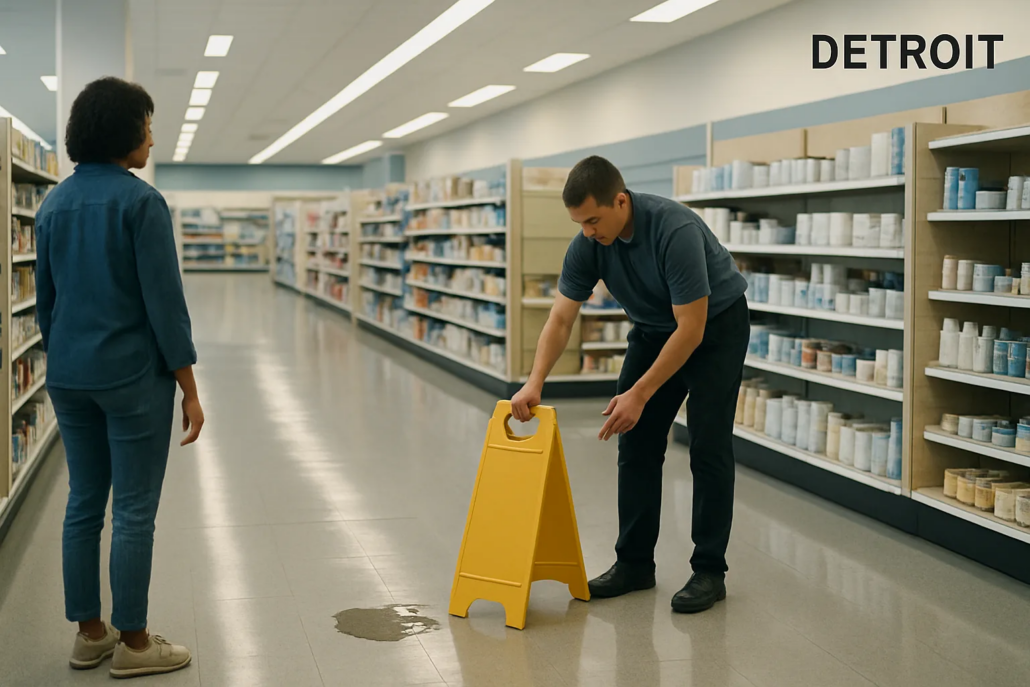
What Evidence Does a Detroit Premises Liability Lawyer Need?
A busy shopping trip can change quickly when a customer slips on a spill, is struck by falling merchandise, or trips over a damaged fixture. If you are asking whether you need a Detroit commercial premises liability lawyer, the answer may depend on facts that are easy to lose within hours or days. A Michigan Appeals Court ruling involving a fruit-market slip and fall illustrates why the exact condition, location, and available proof can matter.
Neumann helps readers understand the issues that commonly arise after an injury inside a Detroit store, shopping center, restaurant, or other business property. This article explains who may bear responsibility, what evidence to gather, how to communicate with the business or an insurer, and why medical records and documented limitations matter. Michigan law applies to the legal analysis, and the outcome depends on the particular facts.
What Evidence Supports a Detroit Commercial Premises Liability Lawyer’s Review?
A commercial premises claim usually turns on more than the fact that an injury occurred. The condition that caused the injury, whether the business knew or should have known about it, and whether reasonable steps were taken to address it may all be relevant. Different hazards can raise different questions, including:
- A spill: How large was it, where was it, and how long may it have been present?
- Falling merchandise: Was shelving overloaded, unstable, damaged, or improperly arranged?
- Broken fixtures: Was a railing, chair, display, floor surface, or other fixture loose or defective?
- Lighting: Did inadequate illumination make a hazard difficult to see?
- Elevators and escalators: Was there a stopping, leveling, mechanical, or maintenance issue?
- Entrances: Was the doorway, threshold, mat, or interior transition unsafe?
Why the exact hazard matters
A general statement that a store was “unsafe” may not show what happened. Photographs should, when possible, capture the hazard from several angles, its surrounding area, nearby warnings, lighting, and the route a shopper was taking. If the condition changes quickly, photographs taken soon after the incident may be especially useful.
Preserve receipts, membership records, parking information, and other proof showing when you were at the property. These materials may help establish the location and timing of the event. Witness names and contact information can also be important, particularly when employees, companions, or other shoppers observed the condition or the immediate aftermath.
Who May Be Responsible for an Injury Inside a Detroit Store?
The business where an injury occurred is not always the only entity that may be relevant. Responsibility can depend on who controlled the area, who created or maintained the condition, and who had notice of a problem. Potentially relevant parties may include a store tenant, property owner, shopping-center operator, maintenance contractor, elevator or escalator service provider, security company, or display installer.
A Detroit Auto Show premises-liability decision involving Mercedes-Benz shows why the relationship between an entity and the area where an incident occurred can be significant. A lawyer evaluating a Detroit claim may examine contracts, maintenance responsibilities, inspection practices, incident reports, and communications among the entities involved.
A practical evidence checklist
After an injury in a store Michigan claim, a visitor may want to preserve or request information such as:
- An incident report or other written record made by store personnel.
- Photographs or video of the hazard, surrounding area, signs, lighting, and footwear or property involved, if relevant.
- Names and contact information for witnesses and employees who responded.
- Receipts, transaction records, appointment confirmations, or other proof of the visit.
- The store’s written instructions for reporting accidents, if provided.
- Information about surveillance cameras and the approximate time period they may cover.
A shopper generally may ask the business to preserve potentially relevant surveillance, but a request does not necessarily guarantee that footage will be retained or released. Surveillance systems may overwrite recordings, and access can depend on the circumstances and legal process. Promptly documenting the request and discussing preservation options with counsel may be useful.
What Should You Do After a Detroit Slip and Fall Store Claim?
The steps taken after an incident can affect what evidence remains and how the injury is documented. Generally speaking, seek appropriate medical evaluation for symptoms or concerns. Medical professionals, rather than an article, should assess the injury and discuss care. Keep bills, visit summaries, restrictions, referrals, and treatment records that you receive.
A claim is not limited to the first emergency-room or urgent-care record. Ongoing symptoms, follow-up care, work limitations, and possible future treatment may require additional documentation. A Michigan premises-liability ruling on future medical expenses explains why proving an injury and documenting future losses can involve more than presenting an initial medical bill.
Communications and common mistakes
Businesses or their insurers may contact an injured visitor for information, a recorded statement, medical authorization, or a proposed resolution. Avoid guessing about how long a hazard existed, minimizing symptoms, or making broad statements about fault. Keep communications accurate and limited to what you know. Do not alter photographs or discard relevant clothing, footwear, personal items, or notices.
Common issues that can complicate a business negligence injury claim include:
- Leaving before reporting the incident when it is safe and practical to do so.
- Failing to record the exact location or condition of the hazard.
- Waiting to obtain evaluation despite continuing symptoms.
- Posting detailed descriptions or photographs of the incident on social media.
- Assuming the store is automatically responsible simply because the event occurred there.
- Accepting or signing documents without understanding what they address.
Michigan premises-liability law, including rules concerning notice, comparative fault, and the condition’s visibility, can be fact-specific. Laws and procedures vary by location and may change, so a Detroit attorney may need to review the property, records, communications, and medical evidence before explaining possible options.
Frequently Asked Questions
Can a store be responsible if an employee did not see the hazard?
Possibly, depending on the facts. A business’s responsibility may involve whether it created the condition, knew about it, or should have discovered it through reasonable inspection or maintenance. The absence of a witness who saw the hazard appear does not by itself answer every legal question. Timing, surveillance, inspection records, employee testimony, photographs, and the nature of the condition may all matter under Michigan law.
What if I did not take photographs immediately after the incident?
The absence of immediate photographs does not automatically resolve a claim. Other evidence may include witness accounts, incident reports, surveillance, store records, receipts, photographs taken later, and medical documentation. However, a changed or repaired condition can make proof more difficult. A Detroit commercial premises liability lawyer can help identify what evidence may still be available and how it relates to the claimed hazard.
Does an incident report prove that the business was negligent?
No. An incident report may help establish that an event was reported, when it occurred, and what information was available at the time. It does not necessarily prove the cause of an injury, notice, or legal responsibility. The report should be preserved with photographs, witness information, medical records, and other evidence rather than treated as a complete determination of fault.
Can I bring a claim if another company maintained the elevator or escalator?
Potentially, but the answer depends on control, maintenance duties, the equipment’s condition, notice, and other facts. The store, property owner, maintenance provider, or another entity may have different roles. Contracts and service records can be important. An attorney licensed to practice in Michigan can evaluate the relationships and explain how the facts may affect available legal options.
How Neumann Can Help
Neumann is dedicated to helping injured visitors understand the evidence and legal issues that may arise after an incident on commercial property. The firm can review photographs, incident reports, witness information, receipts, surveillance concerns, medical records, and communications with a business or insurer. It can also examine whether other entities may have controlled or maintained the area.
Every situation is different, and no attorney can promise a particular result. Neumann is committed to fighting for clients’ rights while providing a clear assessment of the available information. Contact the firm for a free consultation or case evaluation regarding your potential Detroit premises injury claim.
The information in this article is for educational purposes only and does not constitute legal advice. Contact a qualified attorney licensed in Detroit for advice specific to your situation.


Leave a Reply
Want to join the discussion?Feel free to contribute!