
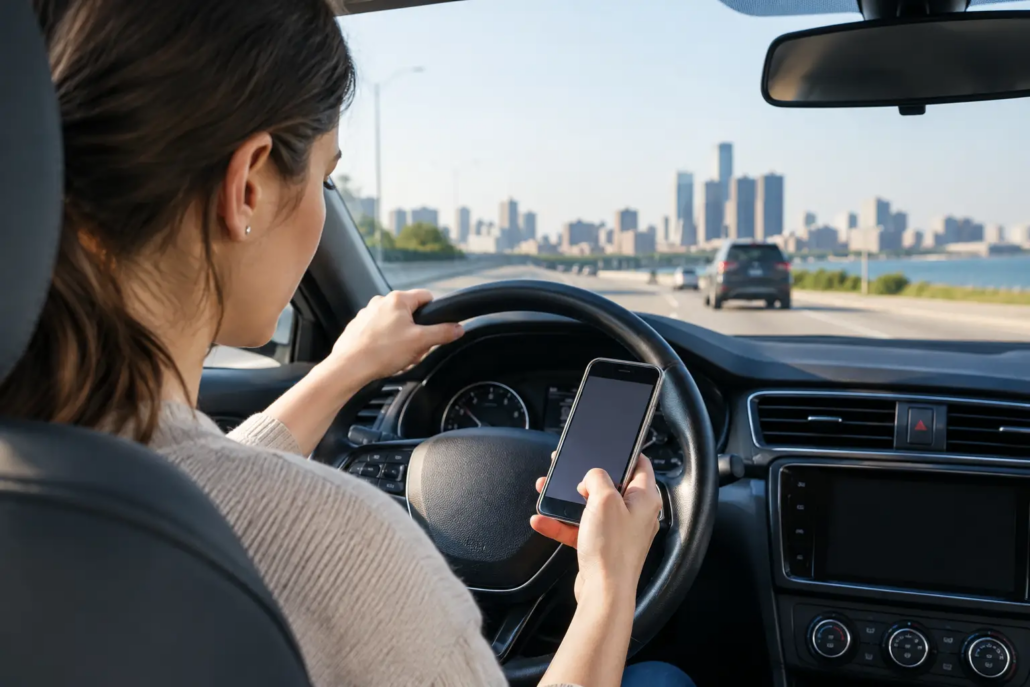
Distracted Driving Guide for Michigan Crash Victims
A driver looks down for a text, reaches for a dropped item, or turns to quiet a child in the back seat. In the seconds that follow, a vehicle can cross the centerline, miss stopped traffic, or enter an intersection without seeing a pedestrian. This distracted driving guide explains what Michigan crash victims should know after a collision caused by inattention, including the evidence that may disappear quickly and the insurance steps that can protect an injury claim.
Distracted driving crashes are not minor simply because the distraction lasted only a moment. At highway speed, a vehicle travels hundreds of feet in a few seconds. The impact can leave a driver, passenger, cyclist, or pedestrian with traumatic brain injuries, spinal injuries, fractures, internal injuries, and pain that disrupts work and family life for months or years.
What Counts as Distracted Driving?
Most people associate distracted driving with texting. Phone use is a major risk, but distraction takes several forms. A driver may be visually distracted by a navigation screen, cognitively distracted by an intense conversation, or manually distracted while eating, grooming, adjusting controls, or searching through a bag.
Some of the most dangerous crashes happen when distractions combine. A driver who is holding a phone, reading a message, and thinking about what to say in response is not giving the road the attention it requires. Even hands-free technology can create cognitive distraction when a conversation pulls a driver’s focus away from changing traffic conditions.
Michigan law restricts the use of handheld electronic devices while driving, but a traffic violation is only part of the picture after a serious collision. The central question is whether the driver’s conduct caused the crash and the injuries that followed. A distracted driver may rear-end stopped traffic on I-94, run a red light in Detroit, drift into oncoming lanes near Traverse City, or fail to yield to a pedestrian in Grand Rapids.
Why Distraction Is So Difficult to Prove
A crash scene often tells part of the story, not all of it. A driver may say they never saw the vehicle ahead, but they are unlikely to volunteer that they were scrolling through a phone. By the time an injured person is home from the hospital, physical evidence may be repaired, erased, or lost.
That is why early documentation matters. The police report may identify witness observations, a driver statement, vehicle positions, roadway conditions, and whether officers issued a citation. It is useful, but it is not always the final word on fault. Police officers arrive after the collision and may not have access to every source of evidence.
Phone records may help establish whether a call, text, or data activity occurred near the time of impact. Vehicle event data recorders can sometimes show speed, braking, steering, or acceleration information. Nearby homes, businesses, traffic cameras, dash cameras, and commercial vehicles may have video that captures the crash or the moments leading up to it. These sources can be time-sensitive. Footage may be recorded over within days or weeks, and damaged vehicles can be repaired or totaled before they are inspected.
Evidence to Preserve After a Michigan Crash
If your medical condition permits, take photos of vehicle damage, the intersection or roadway, debris, skid marks, traffic signals, visible injuries, and anything inside the other vehicle that may suggest distraction. Save screenshots of calls, texts, or social media communications that are relevant to the collision. Keep the names and contact information of witnesses, first responders, and passengers.
Just as important, preserve your own records. Start a simple daily log that identifies your symptoms, appointments, medications, missed work, sleep problems, and activities you can no longer do without pain. Medical records explain the diagnosis. Your day-to-day account can help show how a distracted driving crash changed your life.
Avoid posting detailed crash accounts, injuries, or activity updates on social media while an insurance claim is pending. Insurers can take a single photo or sentence out of context. The safest approach is to keep information private and communicate carefully.
Get Medical Care Before You Minimize Your Injuries
Adrenaline can hide serious injuries immediately after a collision. A person may decline an ambulance, go home, and later develop severe neck pain, headaches, dizziness, numbness, abdominal pain, or confusion. Delayed symptoms do not mean the injury is unconnected to the crash. They do mean prompt evaluation is wise.
Follow through with recommended treatment and tell each provider how the collision happened and when symptoms began. Gaps in treatment can give an insurer an argument that injuries were not serious or were caused by something else. There are practical reasons for gaps, including transportation problems, pain, work obligations, and difficulty finding an appointment. If that happens, document the reason and return to care as soon as you can.
For families, the priority is often getting an injured loved one stable. Still, do not let insurance paperwork sit unanswered for too long. Claim notices, benefit applications, medical bills, and requests for statements can arrive while you are focused on recovery.
Michigan Insurance Issues After a Distracted Driving Crash
Michigan’s no-fault system can provide Personal Injury Protection, commonly called PIP, medical benefits for people injured in a motor vehicle crash. The available benefits and the insurer responsible for paying them can depend on the injured person’s household policies, selected coverage, policy coordination, employment status, and the facts of the crash.
That is one reason it is risky to assume the other driver’s insurance will handle your immediate medical bills. In many situations, an injured person’s own auto insurer, a resident relative’s insurer, or another identified insurer may be responsible for PIP benefits. Coverage questions become even more complicated when the injured person was a passenger, pedestrian, bicyclist, rideshare occupant, or driver of a borrowed vehicle.
Notify the appropriate insurers promptly and keep copies of every form, letter, medical bill, explanation of benefits, and email. Do not discard a denial notice or assume it is correct because it came from an insurance company. A denial may involve missing information, a disagreement about medical necessity, a coverage-priority dispute, or an incorrect interpretation of the policy.
Fault still matters in many cases. Depending on the injuries, available coverage, and circumstances, a distracted driver may be responsible for noneconomic losses such as pain and suffering, as well as certain economic losses not covered by applicable no-fault benefits. The path forward depends on the facts, the severity of the injury, and the insurance policies involved.
When a Commercial or Rideshare Driver Was Distracted
Distraction cases involving delivery vans, semitrucks, buses, and rideshare vehicles often require faster action. A commercial driver may have electronic logs, dispatch communications, in-cab cameras, GPS data, and employer policies that are relevant to the collision. The company may also begin its own investigation right away.
These cases can involve multiple insurance policies and multiple potentially responsible parties. A truck driver’s phone use is one issue. So are the motor carrier’s training practices, supervision, scheduling demands, vehicle maintenance, and compliance with safety rules. An injured person should not be expected to untangle those questions while recovering from a life-altering crash.
Protect Yourself When an Insurer Calls
An insurer may contact you quickly, sometimes before you understand the diagnosis or know the full cost of treatment. You can provide basic claim information, but be cautious about recorded statements, broad medical authorizations, and early settlement offers. A fast offer may not account for future therapy, surgery, lost earning capacity, chronic pain, or the effect of a brain or spinal injury on daily independence.
You do not need to prove the entire case from a hospital bed. What you do need is a record of the crash, consistent medical care, notice to the correct insurers, and timely preservation of evidence. If liability is disputed, benefits are delayed, or the other driver appears to have been distracted, early legal review can help identify what needs to be protected before it is gone.
A distracted driver’s split-second choice should not leave you carrying the financial and physical burden alone. Keep your records, prioritize your recovery, and seek help promptly when the facts or insurance company are making a difficult situation even harder.


Leave a Reply
Want to join the discussion?Feel free to contribute!