
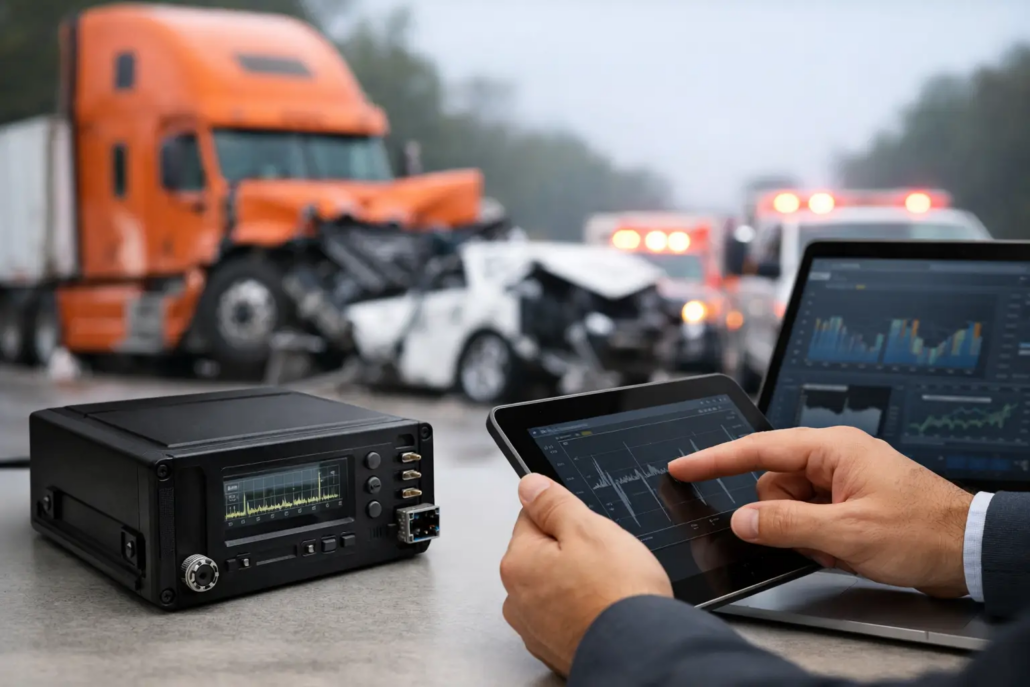
Truck Black Box Evidence in Michigan Crash Claims
A fully loaded commercial truck can travel the length of a football field before its driver has time to react. After a violent crash on I-75, I-94, US-131, or a local Michigan roadway, truck black box evidence Michigan victims need may show what happened during the critical seconds before impact – when memories are incomplete and the trucking company is already building its defense.
For an injured driver, passenger, or grieving family, this information can be the difference between an insurer calling a collision unavoidable and the evidence showing excessive speed, late braking, or unsafe operation. But the data may not remain available for long. Some systems overwrite information when the truck is operated again, repaired, or placed back into service.
What Is Truck Black Box Evidence in Michigan?
“Black box” is the common term for electronic data recorded by a commercial truck. The equipment is not necessarily black, and it is not always a single device. A tractor-trailer may contain an engine control module, event data recorder, electronic logging device, GPS or telematics system, dash camera, collision-avoidance system, and other onboard technology.
These systems can record different information. Depending on the make, model, configuration, and circumstances of the crash, the available data may show the truck’s speed, throttle position, brake use, steering inputs, cruise-control status, engine RPM, seat belt use, and hard-braking events. It may also reveal location information, hours-of-service records, route history, driver behavior alerts, or video footage.
No two trucking cases are identical. A truck’s event data recorder may capture only a short period before and after a significant impact. A fleet telematics system may preserve much more. The key is identifying what systems existed and acting before the carrier can overwrite, replace, or lose the information.
Why This Evidence Can Matter After a Serious Truck Crash
Truck crashes often cause life-altering harm because of the size and weight difference between a commercial vehicle and a passenger car. Survivors may face traumatic brain injuries, spinal injuries, broken bones, internal injuries, chronic pain, and months away from work. Families who lose someone in a collision deserve answers that are based on evidence, not assumptions made at the roadside.
Black box data can help test the story told by the truck driver or trucking company. If a driver says traffic stopped without warning, for example, recorded speed and braking information may show whether the driver was following too closely or reacted too late. If the driver claims the truck was traveling at a safe speed, the data may provide an objective answer.
The evidence can also be useful where fault is disputed. Michigan crashes can involve complicated circumstances: a multi-vehicle chain reaction near Detroit, a winter-weather collision outside Traverse City, an intersection crash in Grand Rapids, or a highway wreck involving a truck, a rideshare vehicle, and several insurers. Electronic records may help reconstruct the sequence of events when witness accounts differ.
Still, black box evidence is not magic. Data must be properly downloaded, interpreted, and considered alongside the police report, crash-scene photographs, vehicle damage, witness statements, inspection records, driver logs, dispatch communications, and medical evidence. A number on a report without the proper context can be misleading. That is why a careful investigation matters.
The Most Valuable Records May Be Controlled by the Trucking Company
After a crash, the trucking company, its insurer, and its investigators may move quickly. They may inspect the truck, photograph the scene, download data, repair equipment, and begin evaluating their exposure. Injured people are rarely in a position to do the same while receiving emergency care or trying to manage pain, appointments, and lost income.
This imbalance is one reason early evidence preservation is so important. A written preservation demand, sometimes called a spoliation letter or litigation hold letter, can request that the trucking company retain the truck, onboard electronic data, dash-camera footage, driver qualification files, maintenance records, inspection reports, hours-of-service records, dispatch records, and communications connected to the crash.
A preservation request does not guarantee that every record will exist or that the company will agree with every request. It does, however, put the responsible parties on notice that evidence may be relevant. If important evidence disappears after proper notice, that loss can become a serious issue in a legal claim.
The truck itself may be evidence. Damage patterns, tire condition, brake components, lighting, underride guards, load securement equipment, and post-crash mechanical condition can all matter. Allowing a truck to be repaired or destroyed before it is inspected may eliminate facts that cannot be recreated later.
What Should You Do After a Michigan Truck Accident?
Your health comes first. Get emergency treatment, follow medical recommendations, and keep records of every provider, diagnosis, prescription, therapy appointment, and out-of-pocket expense. Michigan no-fault benefits may help pay allowable medical expenses and certain wage-loss benefits, but prompt notice and coverage review are essential. The available benefits and the insurer responsible for paying them can depend on the vehicles, household policies, employment situation, and other facts.
If you are physically able, preserve what you can. Save photographs, video, names of witnesses, the police report number, insurance information, and any messages from the trucking company or insurer. Do not post detailed statements about fault on social media. Do not sign broad authorizations or give a recorded statement to the trucking company’s insurer before you understand what is being requested.
It is also wise to seek legal guidance promptly when a commercial truck is involved. The issue is not simply whether the truck driver received a citation. A civil claim may involve the driver, motor carrier, trailer owner, freight broker, maintenance provider, shipper, or another business. Each party may have separate insurance coverage and separate records.
Questions That Need Fast Answers
An early investigation should identify the carrier that controlled the truck, whether the driver was properly qualified, whether the truck was being monitored by electronic systems, and whether there were prior mechanical or safety concerns. It should also examine whether the driver was fatigued, distracted, speeding, impaired, or pressured by an unsafe schedule.
Federal trucking safety rules may apply to interstate carriers, but the facts still control the case. A violation may be relevant evidence, yet it does not automatically establish every legal issue. Likewise, the absence of a citation does not mean an injured person has no claim. Police officers make difficult decisions at chaotic scenes, often before all electronic and company records are available.
How Black Box Data Fits Into a Michigan Injury Claim
Michigan’s no-fault system can be confusing after a truck crash because there may be both first-party benefit issues and a claim against the at-fault party. Personal Injury Protection, or PIP, issues can involve medical bills, attendant care, wage loss, coordination of benefits, and insurer denials. A separate negligence claim may be available when the injuries meet Michigan’s legal threshold or in other circumstances permitted by law.
Black box evidence may support the negligence side of the case by helping establish how the collision occurred. It can also affect settlement discussions because clear electronic evidence may make it harder for an insurer to shift blame onto the injured person without support.
But waiting for an insurer to conduct the investigation is risky. The insurer has its own financial interests. It may not pursue every record that helps you, and it may interpret disputed evidence in the light most favorable to its insured. Independent review gives injured people a better opportunity to protect their position.
When Families Should Seek Help Immediately
Immediate legal review is especially urgent after a fatal crash, a crash involving catastrophic injuries, a collision with a tanker or hazardous cargo vehicle, a suspected hours-of-service violation, or any wreck where the truck was removed from the scene quickly. The same is true when the carrier’s representative contacts you soon after the collision or asks for a statement.
Neumann Law Group helps Michigan crash victims assess evidence, insurance coverage, and next steps after serious commercial-vehicle collisions. A free consultation can provide practical direction even when you are still waiting for medical answers or trying to understand which insurer should pay.
You should not have to prove what happened while recovering from a devastating collision. Protect your medical care, preserve every document you receive, and seek help before critical truck data becomes another unanswered question.


Leave a Reply
Want to join the discussion?Feel free to contribute!