
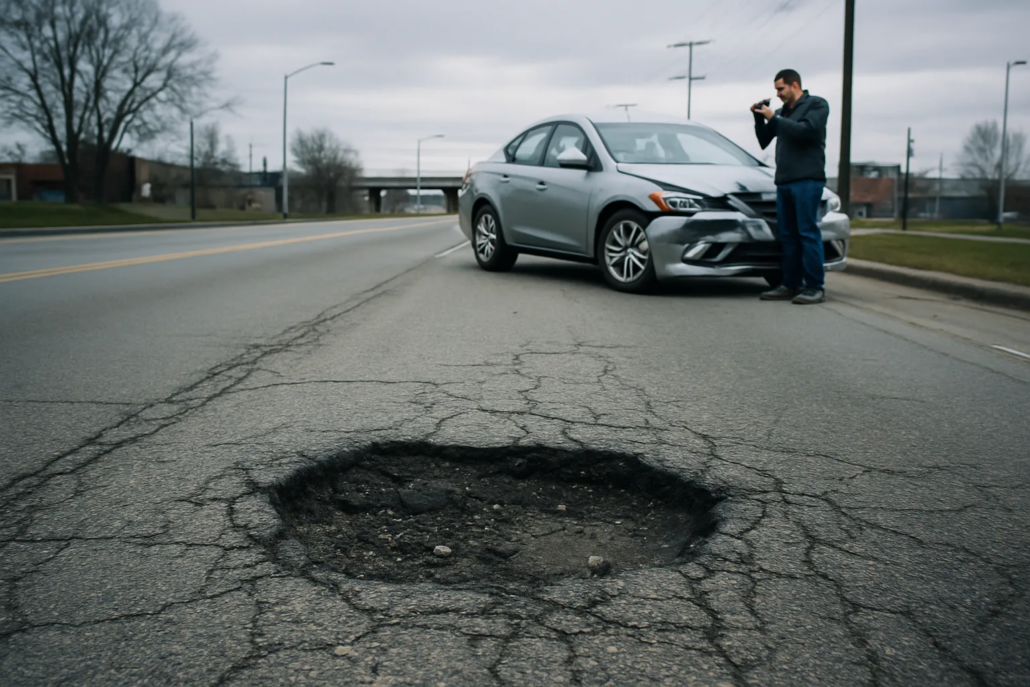
What Evidence Can Support a Michigan Pothole Crash Claim?
A pothole can look like a minor pavement problem until it causes a driver to lose control, damages a wheel, or sends a motorcyclist to the ground. If a road defect contributed to your crash, you may wonder: could a Michigan pothole accident claim succeed in court? The answer depends on more than the fact that a pothole existed. A claimant generally must identify the responsible governmental entity, show that the condition created a legal roadway hazard, connect it to the crash, and prove the resulting injuries or losses.
Michigan road agencies may have immunity from some lawsuits, and special notice rules can apply to claims involving public roads. That makes early evidence important. Neumann can help injured road users understand the issues that may affect a claim. This article explains what to document immediately, how weather and warnings can affect the analysis, and why motorcycles and single-vehicle crashes often require careful reconstruction.
When Can a Michigan Pothole Accident Claim Support an Injury Case?
A road defect claim is not established simply because a crash happened near a pothole. The evidence must usually connect a specific condition—such as a pothole, debris, poor pavement transition, inadequate signage, or unsafe design—to the loss of control or collision. The responsible party may be a city, county, or state agency, depending on who owned or maintained that portion of the road.
Identify the road and the responsible agency
Start with the exact location: street name, direction of travel, nearest intersection, lane, mile marker, GPS pin, and nearby landmarks. Detroit streets, Grand Rapids roads, county routes, and state highways may fall under different jurisdictions. An attorney may investigate maintenance responsibility, inspection records, prior complaints, repair history, and whether the agency had notice of the condition.
The roadway’s design can matter as well as its surface. Curves, lane configuration, drainage, lighting, barriers, and signs may be relevant when evaluating causation. For context on how roadway design questions can require detailed investigation, see the Grand Rapids crash involving US-131 roadway design concerns.
Governmental immunity and notice
Michigan governmental immunity can make claims against public entities more complicated than ordinary negligence claims. Exceptions and procedural requirements may apply, but they are fact-specific. Notice requirements can also be strict, and the applicable deadline may depend on the agency and type of claim. Waiting to report or investigate a defect can make it harder to show what the agency knew and when it knew it.
A Michigan road defect injury lawyer can evaluate these issues under current Michigan law. Laws and procedures may change, and the correct analysis may differ between Wayne County, Kent County, and other jurisdictions.
What Should You Document After a Michigan Road-Defect Crash?
Evidence can disappear quickly. A pothole may be filled, debris removed, snow melted, or warning signs installed after the incident. If you can do so safely, preserve information before the scene changes. Do not enter traffic or delay emergency medical care to collect evidence.
Useful documentation may include:
- The precise location, travel direction, lane position, and route taken.
- Multiple photographs and video of the defect from close range and from the driver’s approach.
- Measurements of the pothole’s length, width, and depth, using a safe reference object rather than entering traffic.
- Weather, precipitation, ice, standing water, darkness, glare, visibility, and lighting conditions.
- Nearby warning signs, cones, barriers, lane markings, construction devices, or the absence of warnings.
- Vehicle damage, tire or wheel damage, debris, skid marks, motorcycle tire tracks, and the approach path.
- Names and contact information for witnesses, responding officers, tow operators, and nearby businesses with possible video.
- Medical symptoms and when they began, along with records from medical providers.
Photographs should show scale and perspective without altering the scene. Notes made soon after the event may help preserve details that later become difficult to recall. Michigan road-safety guidance for winter weather provides additional context for documenting snow, ice, reduced visibility, and other conditions without assuming that weather alone determines responsibility.
How Do Motorcycle Falls and Single-Vehicle Crashes Affect Proof?
A pothole motorcycle accident in Michigan may involve substantial evidence even when no other vehicle made contact. Motorcycles can be affected by pavement gaps, uneven surfaces, loose gravel, standing water, debris, and abrupt transitions. A rider’s protective equipment, damaged foot pegs, handlebars, wheels, and the position of the motorcycle can help investigators assess what happened. Those facts do not automatically prove that a road defect caused the fall, so the approach path and competing explanations should be examined carefully.
A single-vehicle crash also does not rule out a roadway-related claim. The investigation may consider whether the pavement, lane markings, lighting, signs, barriers, or road geometry contributed to the event. Relevant evidence may include:
- The vehicle’s direction, lane, speed information if available, and route before the crash.
- Photographs taken before towing, repairs, or road work changed the scene.
- Vehicle damage, event-data information when available, and physical evidence on the roadway.
- Weather, lighting, visibility, and whether the condition could reasonably be seen from the approach.
- Statements from witnesses and records of prior complaints or maintenance activity.
The Detroit Lodge Freeway rollover involving roadway-safety questions illustrates why a single-vehicle event may require examination of more than driver conduct. Similarly, the Grand Rapids motorcycle crash that raised roadway-safety questions reflects why roadway evidence should be preserved without assuming the cause before an investigation. For additional context on this issue, see What Caused the Fatal Semi-Truck Crash in Grand Rapids, Michigan?.
Common mistakes include leaving the scene without recording the location, posting speculation instead of preserving facts, assuming the city owns the road, and overlooking notice deadlines. A lawyer may also need to consider available no-fault benefits, health coverage, property damage, and any evidence that another driver contributed to the collision.
Frequently Asked Questions
Does a city automatically pay for injuries caused by a pothole?
No. A city, county, or state agency may raise governmental immunity, and a claimant generally must satisfy the requirements of a relevant exception. The evidence may need to show a qualifying roadway condition, agency responsibility, notice, causation, and compensable injury. The analysis depends on the road, facts, and current Michigan law. A consultation can help identify which governmental entity and deadlines may be involved.
Can I bring a claim if the pothole damaged my car but I was not visibly injured?
Vehicle damage alone may not establish a personal injury claim. Some symptoms develop later, but medical concerns should be addressed by an appropriate healthcare professional rather than assumed to be caused by the crash. Property damage and injury claims may involve different proof and coverage questions. Preserving photographs, repair estimates, witness information, and the road-condition evidence may still be important.
What if snow or water covered the pothole in Detroit or Grand Rapids?
Covered defects can make photographs, weather records, witness accounts, and approach visibility especially important. Snow, water, darkness, or glare may affect whether a driver could see the condition, but weather does not automatically resolve responsibility. Evidence should show the scene as it appeared at the time, including warnings, lighting, and nearby maintenance activity. The legal effect depends on the complete circumstances.
Is a police report enough to prove a road-defect claim?
A police report may preserve useful observations, but it may not document every detail needed for a governmental road claim. It may omit measurements, photographs from the approach, agency responsibility, prior notice, or the full medical impact. Additional evidence can include scene images, witness information, maintenance records, vehicle data, medical records, and expert analysis when appropriate. No single document guarantees that causation or liability will be established.
How Neumann Can Help
Neumann is dedicated to helping injured drivers, passengers, and motorcyclists understand the evidence and legal issues that may affect a Michigan road-defect injury claim. The firm can review the location, photographs, vehicle damage, medical documentation, witnesses, and available information about road ownership or maintenance. Its team is committed to fighting for clients’ rights while explaining potential governmental immunity, notice requirements, causation questions, and insurance issues in clear language.
If you were injured in Detroit, Grand Rapids, or elsewhere in Michigan, contact Neumann for a free consultation or case evaluation. The firm is ready to evaluate your situation and discuss your legal options without promising a particular result.
The information in this article is for educational purposes only and does not constitute legal advice. Contact a qualified attorney licensed in Michigan; Detroit; Grand Rapids for advice specific to your situation.

